For Product Information Call M J Vail Company


Stronghold
Work Supports
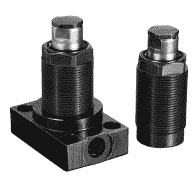
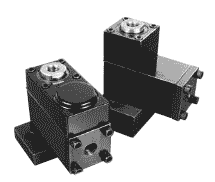
DESTACO offers two designs of work supports: Block style and Threaded Body style. Both styles have the features that give them numerous advantages over typical makeshift supporting methods.

Fixturing is faster, more accurate, and more consistent because shimming and screw jacks are totally unnecessary. Any manual intervention is completely eliminated.

All of DESTACO’s work support models provide the stability that prevents deflection and vibration of the workpiece during machining. Automatically adjusting to varying sizes or locations of the workpiece, they can also be used as adjustable rest pads under clamps.

All DESTACO work supports are rated at 5,000 psi maximum. Minimum pressures vary by style. A work support is typically used with a sequence valve in the hydraulic system, although it is not always required.

When used to prevent vibration/deflection of the workpiece, the clamps in the system are usually actuated first to position the part. The work support is then sequenced to lock the plunger in place.

When used as a support under a clamp, the work support must be actuated first to lock its plunger in position. The clamps are then sequenced to secure the workpiece.


BLOCK STYLE WORK SUPPORTS


Spring and Air Advance

The block style work support use a built-in hydraulic cylinder and internal mechanisms to lock the plunger that contracts the workpiece. They are particularly well-suited to applications with lower hydraulic pressures. A 500 psi minimum system pressure will yield Air Advance/Singleacting consistent supporting. The spring advance versions feature a unique diaphragm breather system to allow the plunger to be cycled in and out without changing the work support’s internal pressure. This means that when the plunger extends, a vacuum will not be developed internally, so there is no tendency for coolant or contaminant’s to be drawn inside.


THREADED BODY WORK SUPPORTS  
Fluid, Spring, and Air Advance

These work supports also use a plunger that extends to contact the workpiece. To support any externally supplied loads, the sleeve surrounding the plunger grips the plunger and holds it, regardless of where it is in its stroke. Extremely close manufacturing tolerances hold the plunger perpendicular to the workpiece and eliminate inaccuracies due to plunger movement during lockup. Made of 100% corrosion resistant materials, this accuracy is easily maintained throughout the life of the work support.

This simple, coaxial design minimizes the number of moving parts and makes these work supports very compact. They are easily threaded into your fixture or can be surface mounted using the available base.

Filtered breathers, where required, keep solid contaminants out of the work support. No external breather lines are necessary.


Fluid Advance/Single-acting

This fluid advanced work support allows the plunger to be retracted out of the way during workpiece load/unload operations. With no hydraulic pressure applied, a spring retracts the plunger into the work support body. The work support provides its own internal sequencing of a piston which raises the plunger until it contacts the workpiece. Maximum flow rates must be observed to ensure proper sequencing. A spring between the piston and the plunger limits the workpiece contact force. The full force generated by this piston cannot be transmitted to the plunger.

As pressure builds, the automatic sequencing action causes the sleeve to grip the plunger and provide the locking action.

A typical operating sequence is as follows:

1. Plunger normally retracted by spring.

2. Hydraulic pressure extends small cylinder causing spring loaded plunger to advance.

3. When plunger contacts the workpiece, the spring begins to compress as the cylinder continues to extend.

4. When the cylinder reaches the end of its stroke, pressure builds high enough to cause the sleeve to grip the plunger.

5. Removal of hydraulic pressure releases the sleeves grip on the plunger and an internal return spring retracts the plunger away from the workpiece.

Spring Advance/Single Acting

Spring advance work supports are the simplest version of hydraulic work supports. As the workpiece is loaded into the fixture, the plunger Block Style Work Supports contacts it, and the weight of the workpiece or the design of the fixture holds the plunger depressed until the work support is hydraulically locked.
Typical operation is:

  1. Plunger normally extended by spring.
  2. Workpieces forces plunger down to supporting position.
  3. Hydraulic pressure locks plunger.
  4. Removal of hydraulic pressure releases plunger.


Air Advance/Single-Acting

Air advance work supports may be specified where:

  • The workpiece is loaded from the side and the extended plunger from a spring advance work support would be in the way.
  • The workpiece is not heavy enough to depress a spring advance work support plunger.
  • The plunger contact force must be precisely adjusted and controlled. Adjusting the air supply pressure will vary the workpiece contact force.
  • Fine contanimants or heavy coolant floods are present.(especially during work support articulation).

A typical operating sequence is as follows:

  1. Plunger normally retracted by spring.
  2. Air pressure applied under plunger overcomes retracting spring force and extends plunger to workpiece.
  3. Hydraulic pressure is then sequenced to lock plunger.
  4. Air and hydraulic pressure must both be removed for plunger retraction.
As an added benefit of air advancw rok supports, pressurized air in the work support body prevents coolant or other contanimants from entering, eliminating the need for berathers, diaphrams, etc.


Call Us
Toll Free! 1-800-526-6003

M.J. Vail Company
10 Ilene Court - Suite 4 - Hillsborough, New Jersey 08844  USA
Phone Toll Free-1 800 526-6003 * In NJ- 908 359-6000
FAX- 908 359-0518